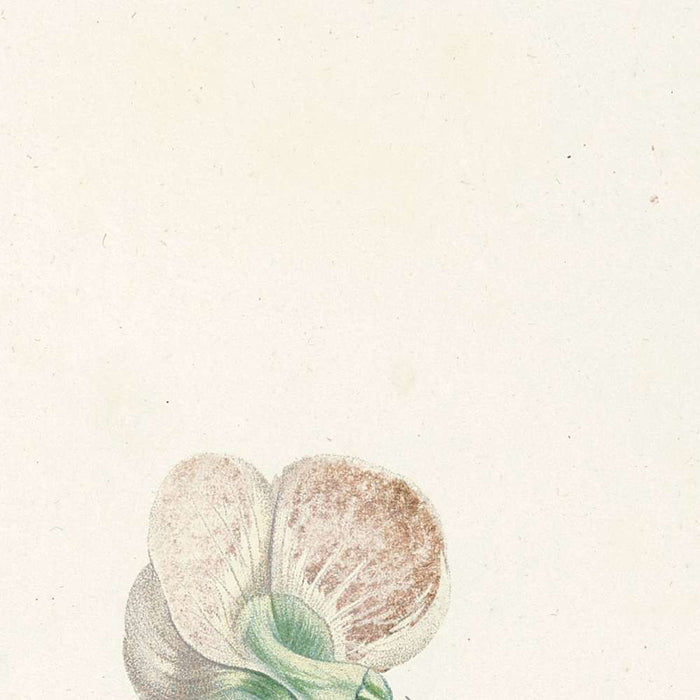
Lathyrus (Plate 15) by Pierre Joseph Redouté, 1805
Lathyrus (Plate 15) by Pierre Joseph Redouté, 1805
✅ Made In USA
✅ Quick Delivery
✅ Cruelty Free
BUNDLE & SAVE
BUNDLE & SAVE
Couldn't load pickup availability
-
Ordered
- - -
Order Ready
- - -
Delivered

Lathyrus (Plate 15) by Pierre Joseph Redouté, 1805
Plate 15 from La botanique de J. J. Rousseau, published in 1805, presents Pierre-Joseph Redouté’s study of Lathyrus, the genus that includes sweet peas and vetchlings. Rather than showing the plant as a single continuous specimen, Redouté arranges blossoms, leaves, pods and seeds across a pale ground. Soft pinks and creamy whites meet fresh, muted greens, while the carefully spaced components allow flower and fruit to be considered with equal attention.
Redouté was among the most celebrated botanical artists working in France around the turn of the nineteenth century, earning the enduring epithet “the Raphael of flowers”. His art belongs to a period in which natural-history illustration combined close scientific observation with highly cultivated design. Produced for a botanical work associated with Jean-Jacques Rousseau, this plate also reflects the philosopher’s sustained interest in botany as a discipline of attentive looking. The specimen is not merely ornamented: its changing structures are set out as an intelligible sequence.
A closer look
The flowers occupy the upper part of the composition, their rounded petals modelled through exceptionally restrained shifts from white to blush pink. Fine lines follow the folds and veins of the petals, preventing the pale blossoms from dissolving into the cream background. A small green leaf near the upper right introduces a sharper note of colour and hints at the plant’s direction of growth, although the surrounding space keeps each element visually distinct.
Below, the emphasis moves from flowering to reproduction. Elongated pods in green-yellow tones are rendered with gentle highlights and slight indentations corresponding to the seeds within. Their smooth outer surfaces contrast with an opened pod near the lower edge, where several seeds become visible. A separate, rounded beige seed at the lower left completes the progression from blossom to mature fruit. These modest details give the plate much of its interest: Redouté makes botanical structure clear without sacrificing the delicacy of the arrangement.
The composition remains shallow and lucid throughout. There is no landscape, soil or surrounding vegetation to establish habitat; instead, ample negative space functions almost like a field of light. Precise contours define the leaves and pods, while stippled and graduated tones lend them volume. In the lower margin, the inscription includes “Composé par P. J. Redouté”, identifying the artist’s role within the publication.
Context and significance
La botanique de J. J. Rousseau appeared at a moment when illustrated botanical books addressed both scientific enquiry and a wider culture of cultivated interest in plants. Rousseau had pursued botany seriously during the later part of his life, valuing direct observation as a means of learning from the natural world. Redouté’s ordered presentation is especially well suited to that approach: the plate isolates significant forms and makes comparison effortless, yet never becomes diagrammatic or austere.
The study’s enduring appeal lies in this balance between evidence and elegance. The pale flower, intact pods, opened fruit and loose seed can be read almost as successive stages in a botanical lesson, but their distribution across the page also creates a poised decorative rhythm. Redouté gives each fragment enough space to be examined on its own, turning the structures of Lathyrus into a quiet study of colour, growth and form.
Choosing the right size and finish
Artwork can feel intimate at smaller sizes and dramatically more architectural at larger ones. Use the room preview, model image and size guide to see how the proportions and scale will work in your space.
If you need an exact size, specialist framing or help planning a larger display, ask our workshop for advice.
The model in the listing images is holding the 18x24in (45x60cm) version of this art print.
Where personalisation is available, you can add a short title or dedication, or one considered visual detail. See examples of personalised artwork.
Choose Original to retain the colour and character of the source artwork, or Aged for a warmer, more antique appearance. See examples of our Aged artwork.
Every piece is produced to archival standards using fade-resistant pigment inks on acid-free matte art paper. Choose an art print, framed art print or framed canvas using the finish options above.
Framed art prints use crystal-clear optical acrylic for excellent clarity, lower weight and safer delivery than glass. Each piece arrives professionally framed and ready to hang.
Selected artworks can be produced at statement sizes up to 3 metres (10ft). Custom sizing and specialist framing are also available. If the exact option you need is not listed, contact our workshop.
Collapsible row
Collapsible row