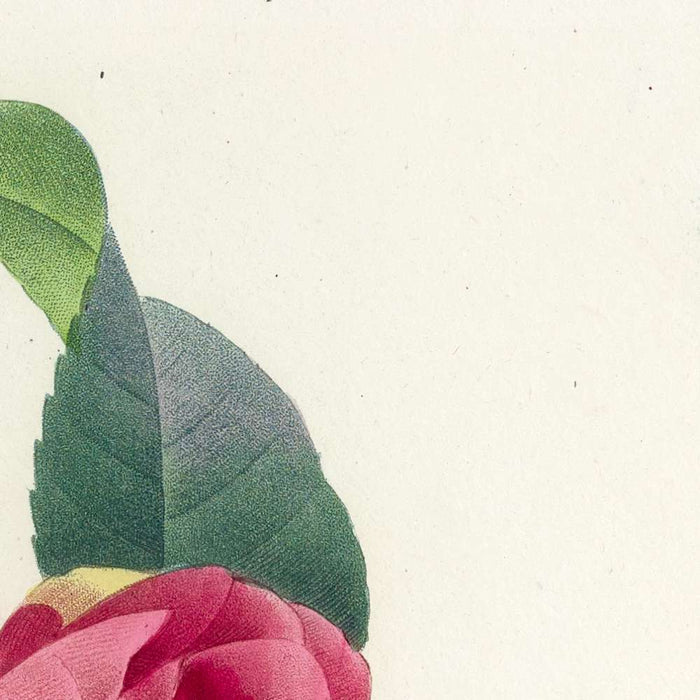
Variegated Camellia (Camellia japonica, Plate 18) by Pierre Joseph Redouté, 1827
Variegated Camellia (Camellia japonica, Plate 18) by Pierre Joseph Redouté, 1827
✅ Made In USA
✅ Quick Delivery
✅ Cruelty Free
BUNDLE & SAVE
BUNDLE & SAVE
Couldn't load pickup availability
-
Ordered
- - -
Order Ready
- - -
Delivered

Variegated Camellia (Camellia japonica, Plate 18) by Pierre Joseph Redouté, 1827
Pierre-Joseph Redouté’s Choix des plus belles fleurs pl 018, created in 1827, presents the camellia labelled “Camellia panach” as a poised arrangement of two open blooms and deep green foliage. The larger flower occupies the centre, its densely overlapping petals shifting from saturated rose pink to creamy white near the heart; above and to the right, a second blossom opens more freely around a cluster of yellow stamens. Set against an expansive pale ground, the branch appears both botanically tangible and carefully composed.
The plate belongs to Redouté’s Choix des plus belles fleurs, a publication devoted to flowers selected as much for their visual distinction as for their botanical interest. Redouté was among the foremost floral illustrators of the late eighteenth and early nineteenth centuries, admired for reconciling close observation with the elegance expected of a deluxe botanical book. His career developed within the cultivated world of French court and garden culture, where rare and ornamental plants were subjects of scientific study, collecting and aesthetic pleasure. Here, the camellia becomes a specimen to examine and an image to contemplate.
A closer look
The composition is subtly asymmetrical. The principal bloom faces outward near the centre, while the smaller flower rises diagonally towards the upper right. Leaves extend in the opposite direction, creating a broad, stabilising fan of green along the left side. A slender stem remains visible below, its gentle bends linking each element without disturbing the generous negative space around it. This restrained structure gives the plant the clarity of a botanical study while avoiding the stiffness of a diagram.
Redouté builds the larger camellia through minute tonal transitions. Pale highlights trace the curved edges of individual petals, while deeper pinks gather where the layers overlap, allowing a complex flower to remain legible. The upper bloom offers a useful contrast: its looser petals expose more of the yellow centre and reveal a different stage or angle of opening. Across both flowers, small variations of blush, crimson pink and warm white prevent the colour from appearing uniform.
The foliage provides the darkest notes. Elongated leaves overlap one another in rich greens, their central veins and finer branching structures precisely articulated. Subtle highlights suggest their glossy surfaces, and a single water droplet resting on one leaf introduces an especially fine naturalistic detail. At the lower edge, the airy plant study is anchored by elegant script: “Camellia panach” appears to the left, while “Camellia japonica. Langlois.” is written at the right. The delicacy of the lettering complements the smooth contours of stem and petal.
Context and significance
Botanical illustration in Redouté’s period occupied a fertile space between science and decoration. Such images recorded defining structures—leaf shape, venation, flower form and reproductive details—but they also transformed individual specimens into balanced page designs. Redouté’s particular distinction lay in preserving both aspects. The camellia is isolated for scrutiny, yet its diagonal growth, alternating masses and controlled colour make the plate feel deliberately graceful rather than merely instructional.
This study also reflects the early nineteenth century’s fascination with natural history and lavishly illustrated flower books. Its appeal rests in the tension between abundance and restraint: the blossoms are luxuriant, almost architectural in their many petal layers, while the surrounding field remains quiet and uncluttered. That contrast allows close observation to unfold slowly—from the broad pink-and-green silhouette to the smallest veins, highlights and droplets.
Choosing the right size and finish
Artwork can feel intimate at smaller sizes and dramatically more architectural at larger ones. Use the room preview, model image and size guide to see how the proportions and scale will work in your space.
If you need an exact size, specialist framing or help planning a larger display, ask our workshop for advice.
The model in the listing images is holding the 18x24in (45x60cm) version of this art print.
Where personalisation is available, you can add a short title or dedication, or one considered visual detail. See examples of personalised artwork.
Choose Original to retain the colour and character of the source artwork, or Aged for a warmer, more antique appearance. See examples of our Aged artwork.
Every piece is produced to archival standards using fade-resistant pigment inks on acid-free matte art paper. Choose an art print, framed art print or framed canvas using the finish options above.
Framed art prints use crystal-clear optical acrylic for excellent clarity, lower weight and safer delivery than glass. Each piece arrives professionally framed and ready to hang.
Selected artworks can be produced at statement sizes up to 3 metres (10ft). Custom sizing and specialist framing are also available. If the exact option you need is not listed, contact our workshop.
Collapsible row
Collapsible row